
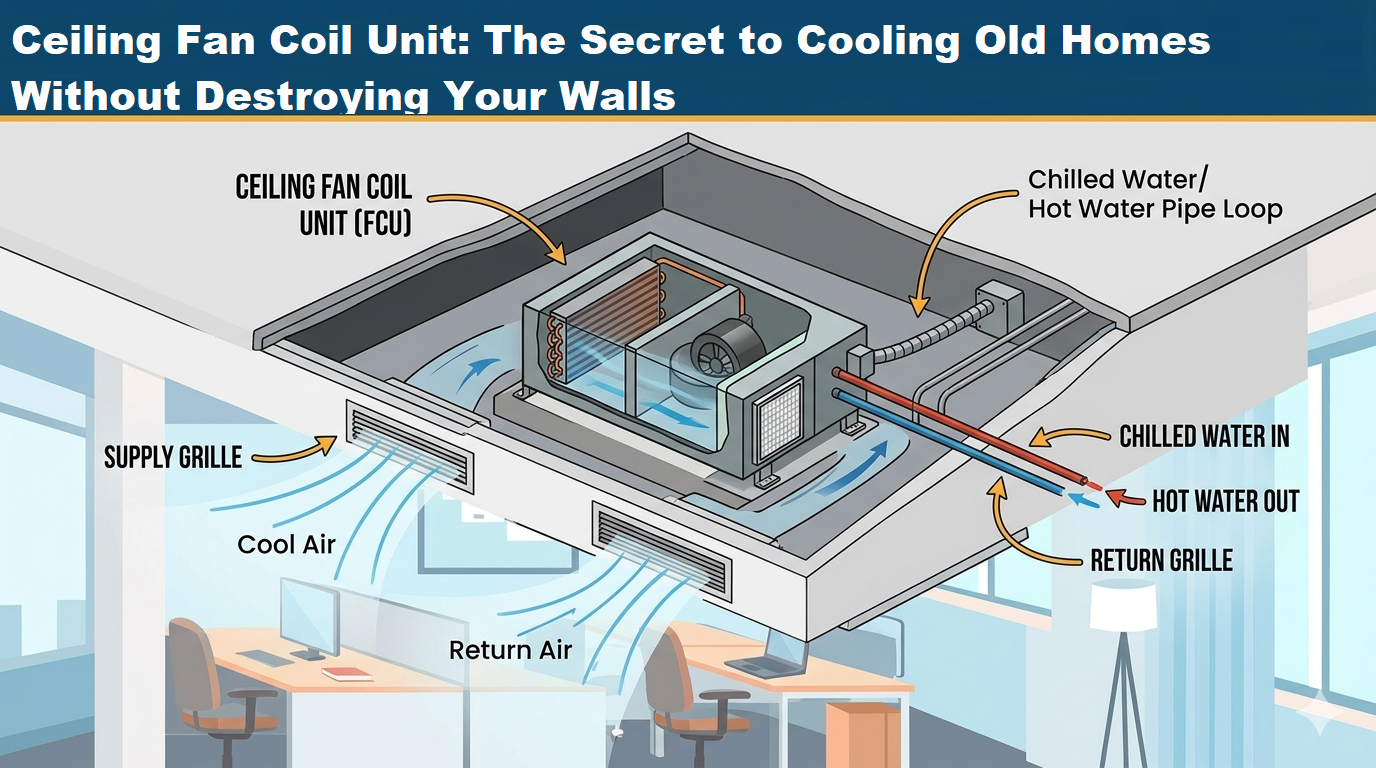
You know that feeling when you love an old house, every creaky floorboard and original wood detail, but you just cannot stand the summer humidity? That was me a few years ago. I had this beautiful century home with plaster walls that were so thick, drilling through them felt like archaeology. Putting in central air with those giant metal ducts was a non starter. It would have meant gutting the place. The solution I found changed everything: a ceiling fan coil unit, part of a high velocity system. It saved my walls and my sanity.
Let’s set the record straight! In most cases, a ceiling fan coil unit refers to the indoor portion of an indirect, high-velocity system; commonly, manufactured by Unico® systems. This is the device that is quietly located in your attic or closet and blows either cold or warm air through thin flexible tubing rather than large ducted metal trunking.
How a Ceiling Fan Coil Unit Actually Works
Forget everything you know about loud, bulky furnaces. The magic is all about physics.
A standard central air system moves a high volume of air at a low speed. That is why those vents are so big. A ceiling fan coil unit flips the script. It uses a special high pressure blower motor to push air at a much higher speed but in much lower volume.
Here is the breakdown. The outdoor unit, just like a normal AC, sends refrigerant into the fan coil unit in the attic. Inside that unit, the air blows over a very cold evaporator coil. But because the coil is so efficient, it wrings out a ton of humidity. The air then gets pushed through flexible tubes that are only about 2 inches wide.
Tiny pipes run through your walls and floors, allowing for a seamless installation. The pipes terminate in ceiling vents roughly equal to the size of a smoke detector. As cold dry air rushes out at high velocities through the ventilation system, a gentle vacuum, referred to as aspiration, is created which pulls the heavier, stale air in the room with it. This will help create a smooth flow of both warm and cold air throughout the entire home; there should no longer be any hot and cold spots in each room. A soft constant cool breeze will be produced that feels more like an early spring day than an ice storm.
Why a Ceiling Fan Coil Unit is a Hidden Gem
So why would you pick this over a standard system? For a whole list of reasons.
It fits when big ducts won’t. Standard ductwork demands wide open chases. A ceiling fan coil unit does not. Those 2 inch flexible ducts can turn corners, go around pipes, and fit into a 3.5 inch wall cavity. This makes it the ultimate retrofit solution for old homes, houses with radiant floor heating, or that addition over the garage where you just cannot squeeze in conventional ducts.
Your home feels cooler, even at higher temperatures. This is the part that surprised me most. Conventional air conditioners remove some humidity, but high velocity systems are champions at it. The Unico system, for instance, is designed to remove up to 30% more moisture from the air than a standard system. Since dry air feels cooler on your skin, you can set your thermostat higher and still feel perfectly comfortable, saving money on your energy bill.
There is less energy loss. Because the tubes are small and fully insulated, they have about one third the surface area of traditional metal ducts. That means less of your expensive cooled air is lost to a sweltering attic before it even reaches your living room.
But It Isn’t For Everyone: Let’s Be Real
Look, no system is perfect. You need to know the downsides before you fall in love with the idea.
The upfront cost is real. Those specialized parts come with a higher price tag. Expect a high velocity system to cost more than a builder grade central air unit. You are paying for the engineering that lets it fit where other ACs cannot. However, when you factor in the money you are not spending on patching up demolished walls and ceilings, the difference might be smaller than you think.
Some people worry about noise. Because the air moves fast, some homeowners imagine it sounds like a jet engine. That is an old myth. Modern systems are incredibly quiet. The tubing is lined with sound absorbing insulation, and the air handlers are mounted on vibration pads. When installed correctly by a professional, the sound is often described as a soft, gentle whisper, no louder than a standard AC vent.
Finding the right installer is crucial. This is the most important point I can make. A standard HVAC company can slap in a conventional furnace. A high velocity system is a specialty. You need a contractor who understands the specific design requirements, duct lengths, and pressure balancing. If the installer gets it wrong, it will not perform well, and it might be noisy.
The Final Verdict: Is a Ceiling Fan Coil Unit Worth It?
If you love your old home, or if you are adding a space that seems impossible to heat and cool, then a ceiling fan coil unit is not just worth it. It is a lifesaver. It preserves the character of your building while giving you the precise comfort of a modern system.
The key is to find a team that specializes in this work. If you are in the Greater Toronto Area and want to see if this sleek, invisible system is the answer to your temperature troubles, I highly recommend looking up a dedicated Unico Fan Coil Installation in Toronto. A good contractor will walk you through the layout, show you the tiny vents, and explain exactly how they will snake the ducts through your home with minimal disruption.
Do not let another summer of hot and cold spots, noisy window units, or the threat of a major renovation dictate your comfort. A ceiling fan coil unit might just be the quiet, powerful hero your home has been waiting for.